
Textile Inspection Software
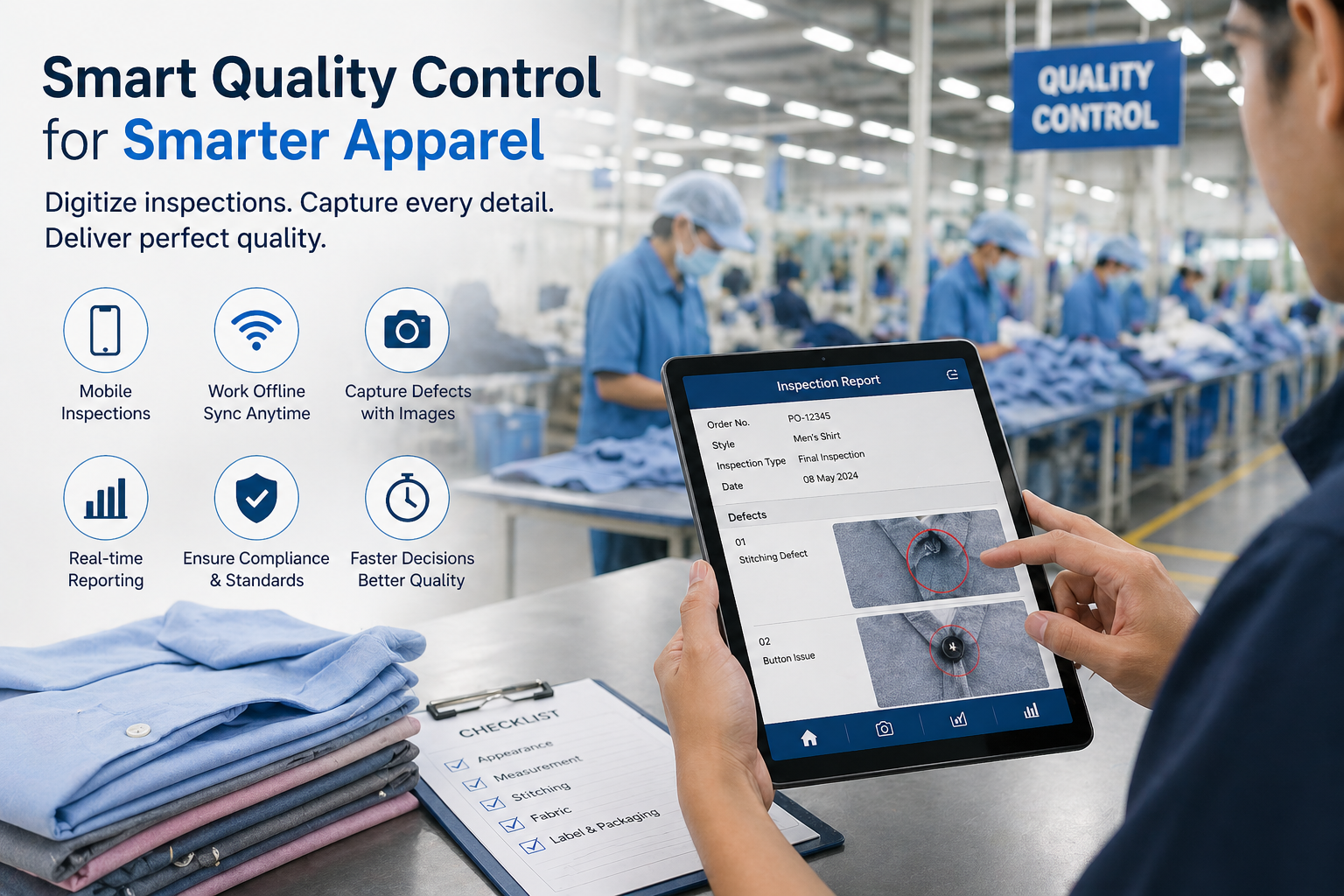
Most textile quality programs rely on disconnected tools like manual tally sheets, WhatsApp shade bands, and outdated spreadsheets nobody fully trusts. The result is a broken system where major defects slip past the roll stage, wasting fabric and increasing the true cost of poor quality up to 20% of your generated annual revenue. QA avoids that by providing one governed platform for every stakeholder in the textile supply chain.
- 4-Point Inspection Engine
Auto-calculates penalty points and standardizes scores using the industry standard formula $\frac{Total\ Points \times 3600}{Width \times Length}$ instantly without the need of manual tally sheets.
- Inspector Mobile App
Captures GPS-stamped offline photos so auditors cannot fake a fabric roll inspection.
- The Roll Kill-Switch
Locks the QA Release Docket automatically when a roll exceeds the 40-point threshold so goods cannot move to the cutting room.
- Live WIP Dashboard
Streams spinning, dyeing, and finishing percentages to the buyer in real time to kill the daily email updates.
- CAP Loop
Issues digital Corrective Action Plans assigned directly to the mill and tracks them to closure.
- Compliance Lock
Tracks GOTS and OEKO-TEX certificates expiry automatically to lock suppliers out of new purchase orders before it becomes a liability.
Built for textiles, not generic audits
Basic tools can't automate complex normalization formulas or toggle buyer-specific grading rules. QA features integrated 4-point calculators and custom grade conversion tables built specifically for fabric supply chains.
Every handoff is locked
From raw yarn to finished roll, every step relies on hard digital locks. Mills cannot alter fabric yield data after production, and inspectors cannot change report scores after GPS sign-off.
Live to every player who needs it
The brand sees defect trends across suppliers. The buying house tracks the fabric yield. The mill monitors open corrective actions while the inspector executes their brief.
Step 01
Brand authors the spec. Purchase order is raised, 4-point acceptance level is set, and fabric technical specifications are signed off.
Step 02
Buying House allocates the scope. The mill is linked to the brand, the inspection framework is set, and quality standards are locked.
Step 03
The inspector runs the audit. The mobile app captures GPS-stamped photos and calculates the penalty points per 100 square yards instantly.
Step 04
Pass or lock. Pass issues the Release Docket and clears the shipment. Fail fires the Kill-Switch and opens a mandatory corrective action plan.
Every major apparel certification — tracked, audited, enforced.
Our auditors are trained against every major social, environmental, and quality standard in global apparel sourcing.

Business Social Compliance Initiative
The most widely required social audit for factories supplying European retailers — labour rights, health & safety, fair wages, working hours, and environmental compliance.
Worldwide Responsible Accredited Production
Prevalent across North & South American supply chains. Certifies lawful, ethical, humane production at Platinum, Gold, or Silver levels.
SEDEX Members Ethical Trade Audit
One of the world’s most used ethical audit formats — 2-pillar or 4-pillar. Results shared directly on the Sedex platform to reduce audit fatigue.
Global Organic Textile Standard
The leading processing standard for textiles made from certified organic fibres — ecological and social criteria across the whole chain.
OEKO-TEX STANDARD 100
Certifies every component of a textile has been tested for harmful substances — essential for childrenswear and intimate apparel.
SA8000 Social Accountability
One of the most rigorous social certifications, based on ILO conventions and the UN Declaration of Human Rights, with ongoing surveillance.
What QA teams say after switching to enforced QA.
“Factories used to claim they never got the updated spec. Now every change needs a digital signature with a timestamp. Disputes about what version was in production dropped to zero in our first season.”
“The COPQ reports were transformative. We could finally show clients in dollar terms how much our inspection programme saved them per season. We renewed three contracts off that data alone.”
“We went live in 11 days. Our auditors work in basements with zero WiFi — the offline app captures everything and syncs later. Factories were trained in an afternoon.”
“Three shipments were held at customs in two years over cert lapses nobody caught. Automatic expiry tracking with PO locks solved it permanently — 18 months without a single lapse.”
“Brands used to complain they had no visibility between PO and shipment. Now they log in and see exactly what stage every order is at, in real time. It transformed those relationships.”
“We cut our pre-shipment failure rate from 18% to under 5% in one season by adding DUPRO at 20% production. The extra visits cost less than a single chargeback we avoided in month one.”
Textile Inspection Software
Those tools were built for basic checklists. Our textile quality control software is built for fabric supply chains with ISO standard calculation engines and garment-specific defect taxonomies. It features a shipment lock that no generic tool offers.
Factories get a free web portal requiring no installation and zero cost to them. The inspector uses the mobile app on iOS or Android. The brand and buying house manage everything from a secure web dashboard.
Most clients run their first live fabric inspection software audit within 14 days of sign-up. Onboarding includes setting up the factory portal, configuring your specific grading thresholds, and a live walkthrough with your team.
Yes. The textile QA system is built for multi-tenancy. A single buying house can manage dozens of brands, each with their own grading standards, factory relationships, and inspection programs separated entirely by hard digital locks.
Lock down your next order.
See the Shipment Kill-Switch and the full inspection flow in a live walkthrough.